Skip to content
[Communication Channels]

Business Messaging Channels

Enterprise Messaging. One Infrastructure. Every Channel.

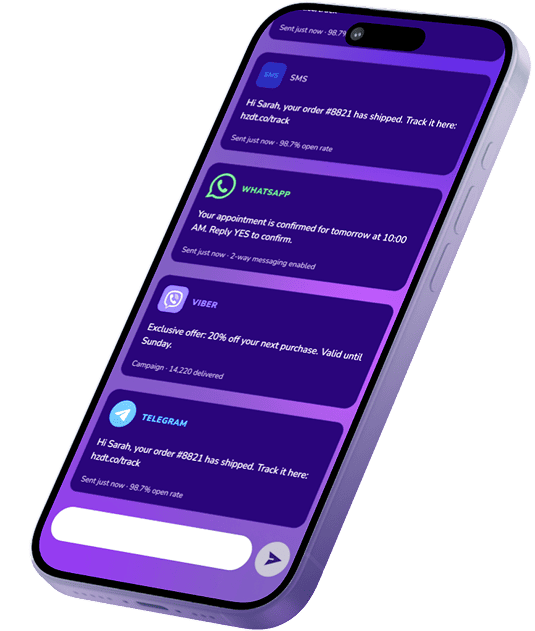
Horizon Dit delivers SMS, WhatsApp Business API, Voice, Push Notifications, Email, Telegram, RCS and Viber through one enterprise messaging platform. Compare each channel and choose the right fit for alerts, verification, customer conversations, service updates and marketing campaigns.

  • Enterprise messaging platform supporting eight channels: SMS, WhatsApp, Voice, Push, Email, Telegram, RCS and Viber
  • Reliable connectivity across the UAE, GCC and wider MENA region, plus international reach
  • API-based integration for transactional, verification, service and marketing messaging
  • Side-by-side comparison to match each channel to its use case
  • Dedicated support for high-volume messaging operations
[Channel Fit]

Why Businesses Use Different Messaging Channels

Most organizations rarely rely on one messaging channel alone. No single channel serves every message equally well; the right choice depends on urgency, format and how much interaction the situation calls for.

  • SMS – universal reach for alerts, OTP codes and time-sensitive notifications, on any handset.
  • WhatsApp – rich, two-way conversations for support and sales interactions.
  • Voice – urgent notifications and automated calls that don't require reading a message.
  • Push – timely updates for customers who already use their app.
  • Email – detailed transactional and marketing content in a format customers can save and search.

The channel should match the message, its urgency, the customer's context and the interaction required, not the other way around.

[Our Channels]

Explore Our Business Messaging Channels

Horizon Dit provides eight messaging channels through one enterprise messaging platform, each suited to a different combination of reach, urgency and interaction. Use the summaries below to see what each channel does well, then open a channel page for full detail on features, use cases and integration.

  • SMS

    Available on any mobile phone without requiring an app or internet connection. Well suited to time-sensitive alerts, one-time passwords and transactional notifications, and remains one of the most broadly compatible channels across devices, countries and carriers.
  • WhatsApp Business API

    Built for two-way conversations using approved message templates and rich media. Useful for ongoing dialogue with a customer, not just a one-way notification, across support, sales and service scenarios.
  • Voice

    laces automated calls for situations where a message needs to be heard rather than read. Useful for urgent alerts, reminders and verification, and for reaching customers who may not check messages promptly.
  • Push Notifications

    Sits within an app or website a customer has already installed or visited, without requiring a phone number or separate opt-in. A cost-efficient way to keep active users informed with timely updates and reminders.
  • Email

    Suited to longer transactional and marketing content that benefits from a structured, saved format, covering invoices, receipts, detailed service updates and campaigns, without functioning as a full email marketing automation platform.
  • Telegram

    Connects with digitally active audiences through bots and automated messaging. Suited to service updates, notification workflows and ongoing customer engagement with users who are already active on the platform.
  • RCS

    A next-generation mobile messaging format with verified sender profiles, images and clickable buttons built into the conversation itself. Suited to those that want a more visual, app-like experience over standard messaging.
  • Viber

    Enables branded messaging for transactional notifications, promotions and customer communication, useful for reaching a broader customer base in specific markets and communities where Viber usage is common.

Whichever channels you choose, all eight run on the same platform and API.

[Channel Comparison]

Compare Business Messaging Channels

Every channel differs in how it reaches customers, whether it supports a reply and how much media it can carry. The table below gives a quick, practical comparison across all eight channels. It is meant as a starting point for narrowing down options, not a full technical specification.

ChannelBest ForTwo-Way CommunicationRich MediaApp Required
SMSAlerts, OTP and universal reachAvailableNoNo
WhatsAppRich two-way conversationsAvailableYesYes
VoiceUrgent, time-sensitive communicationLimited (IVR)NoNo
PushEngaging existing app usersLimitedYesYes
EmailDetailed transactional and marketing contentAvailableYesNo
TelegramBot-driven updates and engagementAvailableYesYes
RCSRich, branded mobile messagingAvailableYesNo
ViberBranded messaging in Viber-active marketsAvailableYesYes

This comparison reflects typical capability, not a guarantee for every account. Actual feature availability can depend on the destination country, the local mobile operator, the specific channel program an account qualifies for, and how the integration is configured. A channel marked as supporting rich media or two-way replies in one market may be more limited in another, which is why channel selection is usually confirmed during setup.

[Choosing a Channel]

How to Choose the Right Messaging Channel

Choosing a channel is less about which one is technically best and more about matching it to the situation. The audience, their geography, how quickly a message needs to arrive, the type of content, how much interaction is needed, whether customers use their app, and any compliance requirements all shape the right choice. The scenarios below are a starting point, not a fixed rule for every situation.

  • Need universal reach?

    Choose SMS. SMS works on any mobile phone without an app or internet connection, which makes it a dependable option when a message has to reach a broad or mixed audience, including customers on older devices or in areas with inconsistent data coverage.

  • Looking for rich two-way conversations?

    Choose WhatsApp. It keeps the exchange in an app many customers already use every day, so they can reply, ask a follow-up or tap a quick-reply button without opening another app. Images and documents fit into the same conversation, a good match for order questions, appointment changes and support requests where the business expects an answer.

  • Sending an urgent, voice-based message?

    Choose Voice. Automated calls get attention immediately and don't depend on a customer opening an app or reading a message, which makes Voice suited to time-critical alerts and reminders that need to be heard right away.

  • Reaching customers who already use your app?

    Choose Push. Push notifications work directly within an existing app relationship, making them a cost-efficient way to keep engaged users informed with updates, reminders and product notifications without adding a new channel to manage.

  • Need detailed or long-form communication?

    Choose Email. Email suits content that benefits from structure and length, such as invoices, receipts and detailed service updates, and gives customers a saved, searchable record that other channels aren't designed to hold.

  • Supporting a Telegram-based audience with automated updates?

    Choose Telegram. Where a customer base is already active on Telegram, bots can deliver automated notifications and service updates efficiently, making it a practical fit for digitally engaged audiences who expect fast, app-like interaction.

  • Want a rich, branded mobile experience?

    Choose RCS. RCS carries verified sender profiles, images and interactive buttons directly in the native messaging app, which suits teams that want a more visual, branded experience without requiring a separate app download.

  • Operating in Viber-active markets?

    Choose Viber. Where a company's customer base includes communities that use Viber regularly, it offers branded messaging for transactional notifications and promotions, reaching those customers through a channel already familiar to them.

[Multiple Channels]

Need More Than One Messaging Channel?

Many organizations don't rely on a single channel. Different stages of the customer relationship call for different types of communication, and combining channels lets each one be matched to its strongest use case.

SMS + Email

SMS handles urgent, time-sensitive notifications, while Email carries the detailed follow-up, such as a receipt or full order summary, that a customer can refer back to later.

WhatsApp + SMS

WhatsApp supports interactive, two-way conversations for customers who use it, while SMS provides broader reach for contacts who don't, giving wider coverage without losing the conversational experience where it's available.

Voice + SMS

Voice delivers urgent alerts that need to be heard immediately, while SMS provides a written record of the same notification for reference.

Push + Email

Push keeps active app users informed in the moment, while Email carries more detailed information for the same update.

Combining channels is different from managing a coordinated omnichannel communication strategy.

[Our Platform]

Messaging Channels Built on Enterprise Infrastructure

These channels are built on one enterprise messaging platform rather than operating as separate standalone products. It runs on a shared operational model, a consistent integration approach and infrastructure built to support high-volume communication.

  1. 01

    Scalable Delivery

    Built to scale with message volume, with redundancy in place to support continued delivery during peak periods.

  2. 02

    Reliable Connectivity

    Consistent delivery quality across partner networks, with data placement options extending to European infrastructure where regional requirements apply.

  3. 03

    API Integration

    Channels connect through a consistent, API-based integration approach, so a development team works with one integration model rather than separate setups per channel.

  4. 04

    Global Reach

    Delivery extends across the UAE, GCC and wider MENA region as well as international destinations, supporting growth beyond one market.

Illustration of messaging infrastructure
  1. 05

    Operational Monitoring

    Ongoing monitoring tracks delivery performance across channels and flags issues as they arise, rather than leaving them to surface downstream.

  2. 06

    Enterprise Support

    A dedicated support team familiar with high-volume messaging operations is available for setup, integration and ongoing changes.

[Ready to Start?]

Find the Right Messaging Channels for Your Business

Choosing the right combination of messaging channels depends on your audience, the countries you operate in, your message volumes and how you need channels to integrate with existing systems. Speak with our messaging specialists about your transactional, verification and marketing use cases, and we'll help map out a channel setup suited to your needs.

Request a Demo
one system every channel full visibility