
Skip to content
[Trusted Across UAE, GCC & MENA]

Mobile & Web Push Notifications for Business

Mobile & Web Push Notifications for Business

Reach customers the moment it matters. On their phone, on their screen, in real time.

Deliver business push notifications to customers across the UAE, Dubai, GCC, and MENA – instantly, reliably, and at scale. Horizon Dit's push notification service helps businesses send mobile push notifications and web push notifications for transactional alerts, account updates, and promotional messages, without depending on email open rates or SMS costs for every interaction.

Request a Demo
  • Mobile and Web Push Notifications
  • Real-Time Customer Alerts
  • Transactional & Promotional Notifications
  • Automated Notification Workflows
  • API & Dashboard Access

Built for Instant Customer Reach

When a customer needs to know now, push gets there first.

  • Instant
    Delivered straight to lock screen or browser, no inbox to check
  • Monitored
    Continuous delivery monitoring across mobile and web
  • Direct
    No filters, no spam folders, no competing inbox clutter
  • Scalable
    Built to handle growing notification volumes as your business expands
[What Are Push Notifications]

The Fastest Way to Reach a Customer Who Already Knows You

  • No Inbox, No Delay

    A push notification appears directly on a lock screen or browser, bypassing inbox filters and spam folders entirely. Customers see it within seconds, not whenever they next check email.

  • Built for Urgency

    Order confirmations, security alerts, and booking reminders lose value the longer they sit unread. Push delivers time-sensitive updates while they're still relevant to the customer.

  • Cost-Efficient at Volume

    Once a customer opts in, push notifications can be sent without per-message SMS costs. Businesses can notify customers far more frequently on order status, account activity, and updates than per-message channels allow.

  • Built on Existing Engagement

    Push reaches customers who already have a relationship with your app or website, making it one of the most direct channels available for reaching an existing customer base.

A push notification platform lets businesses deliver real-time updates to mobile apps and browsers without the friction that slows down other channels. There's no inbox to check and no filter to escape; the message simply appears.

For businesses across the UAE and GCC, push notifications have become a core part of customer communication for e-commerce, finance, healthcare, and logistics operations managing high volumes of daily interactions. Engagement rates for push consistently outperform email for time-bound updates, and the low cost per send makes frequent, relevant communication practical at enterprise scale.

For operations and customer experience teams, enterprise push notifications offer a direct, low-friction channel to keep customers informed without overwhelming their inbox or running up communication costs.

[Push Use Cases]

One Platform. Every Push Notification
Need Your Business Has.

Horizon Dit's push notification platform covers the full range of business notification scenarios, from operational updates that keep transactions moving to promotional messages that drive engagement.

  • Order & Delivery Updates

    Keep customers informed at every stage of a transaction, from confirmation to dispatch and delivery. Real-time updates reduce support inquiries and build confidence in the buying process.

    Examples: Order confirmations · Shipping updates · Delivery tracking · Delivery status changes
    IDEAL FOR: e-commerce platforms, logistics operators, retail businesses
  • Payment & Billing Alerts

    Notify customers of successful payments, upcoming invoice due dates, and subscription renewals before they become support tickets.

    Examples: Payment confirmations · Invoice reminders · Billing notifications · Subscription renewals
    IDEAL FOR: fintech apps, SaaS platforms, subscription businesses
  • Account & Security Notifications

    Alert customers immediately to login activity, password changes, or suspicious account behavior, reaching them faster than email when every minute counts.

    Examples: Login alerts · Password changes · Suspicious activity warnings · Account updates
    IDEAL FOR: banking portals, fintech apps, SaaS platforms
  • Appointment Reminders

    Reduce no-shows for healthcare providers, professional services, and consultation-based businesses with timely booking reminders sent directly to a customer's device.

    Examples: Healthcare appointment reminders · Consultation confirmations · Service booking reminders
    IDEAL FOR: healthcare providers, professional services, beauty and wellness businesses
  • Promotional Campaigns

    Reach engaged customers with special offers, seasonal campaigns, and product launches, without the cost of paid advertising or the friction of email unsubscribes.

    Examples: Special offers · Seasonal campaigns · Product launches · Personalized recommendations
    IDEAL FOR: retail businesses, e-commerce platforms, loyalty programmes
  • Service Announcements

    Communicate planned maintenance, operational changes, or service availability updates to your full customer base, or a targeted segment, in a single send.

    Examples: Maintenance notifications · Operational updates · Service availability changes · Planned interruptions
    IDEAL FOR: SaaS platforms, utilities, service-based businesses
[Mobile Push]

Mobile Push Notifications

Mobile push remains the most direct way to reach customers who have your app installed. A notification appears on the lock screen the instant it's sent, whether the app is open, running in the background, or fully closed.

For businesses across UAE, GCC, and MENA, mobile push notifications work across both Android and iOS, reaching customers regardless of device type. These customer push notifications are particularly effective when app engagement itself is the goal: a customer who opens one is already back inside your product, ready to take the next step.

Always-On Visibility

A push notification reaches the lock screen whether the app is open, backgrounded, or fully closed, putting order tracking, payment alerts, and appointment reminders in front of the customer immediately.

Built on Existing Engagement

Mobile push reaches a customer who already opens your app, without per-message SMS costs, on a screen checked dozens of times a day. Unlike email, it doesn't compete with dozens of unread messages.

Cross-Device, Cross-Platform

Mobile push works across both Android and iOS from a single platform, reaching customers regardless of device type, with unified campaign logic for mixed audiences.

Mobile push notifications work best as part of a broader engagement strategy, one where the app itself is the primary touchpoint and push serves as the trigger that brings the customer back to it.

A retail business sends a push the moment an order status changes, cutting "where is my order" inquiries. A finance app sends a push for every login from a new device, giving customers real-time account security visibility. A healthcare provider sends a reminder two hours before a scheduled appointment, reducing missed visits.

Typical Business Scenarios

  1. Order tracking:
    Customers receive a mobile push the moment their order ships, is out for delivery, or arrives, without needing to check an app manually.
  2. Banking alerts:
    Financial institutions notify customers of transactions, balance changes, or login activity the instant they happen.
  3. Appointment reminders:
    Clinics, salons, and service businesses reduce no-shows with timely reminders sent directly to a customer's device.
  4. Loyalty rewards:
    Retailers notify members of points earned, tier upgrades, or rewards about to expire, encouraging return visits.
  5. Security notifications:
    Businesses alert customers to password changes, new device logins, or suspicious activity, giving them the chance to act immediately. Push notifications can also support authentication workflows as part of Horizon Dit Customer Verification.
[Web Push]

Web Push Notifications

Web push notifications reach customers directly through their browser. No mobile app installation is required, either for the business to send them or for the customer to receive them. Once a website visitor opts in, a business can send updates to their desktop or mobile browser even after they've left the site, reopening the conversation without relying on an email address or phone number.

Mobile push and web push solve different problems. Mobile push depends on a customer having installed and opened your app at least once. Web push depends only on a browser visit and an opt-in click, making it the right channel for businesses that drive most of their traffic through a website, or that want to re-engage visitors who never convert to app users at all.

For e-commerce sites, content platforms, and service businesses operating across the UAE and wider MENA region, web push fills a gap that email alone can't close: the ability to reach a visitor instantly, without needing their contact details first.

  • Abandoned Browsing Reminders
    Re-engage visitors who left items in a cart or browsed a product without completing a purchase, without needing an email address to do it.
  • Website Announcements
    Notify returning visitors of new content, product launches, or platform updates the moment they're live.
  • Service Notifications
    Alert logged-in users to account activity, system status, or service changes directly through the browser they're already using.
  • Account Activity Alerts
    Flag login attempts, profile changes, or security events to web users in real time, without requiring a mobile app.
  • Limited-Time Offers
    Drive urgency around flash sales or time-bound promotions with a notification that reaches the browser instantly, rather than sitting in an inbox.
[Notification Types]

Transactional & Promotional Push Notifications

Push notifications generally fall into two categories, each with a different purpose, tone, and frequency. Understanding the distinction helps businesses use the channel effectively without overwhelming their customers.

Transactional notifications are triggered by something the customer did, a purchase, a booking, a login, a payment, things like payment notifications, order updates, delivery notifications, and account alerts. They're expected and almost always opened.

A transactional notification that arrives late, or doesn't arrive at all, undermines customer trust in a way a delayed promotional message never would. Appointment reminders, security notifications, and shipping updates depend on consistent, on-time delivery.

The balance between the two categories matters: a business that sends only transactional notifications under-uses the channel's commercial potential, while one that leans too heavily on promotional sends risks customers disabling notifications altogether.

[Channel Selection]

Choosing the Right Channel for Real-Time Notifications

Every communication channel has strengths depending on the business scenario. The goal isn't to pick a single channel for every message, it's to match the right channel to the right situation.

Business ScenarioRecommended ChannelTypical Use Case
Mobile app usersPush NotificationsImmediate app engagement and real-time delivery
Website visitorsWeb Push NotificationsReach users directly from the browser without email
Users without an appSMSUniversal delivery across all mobile devices
Interactive conversationsWhatsApp Business APITwo-way communication with rich media support
Urgent voice communicationVoiceSuitable for time-sensitive alerts requiring attention
Channel selection by communication scenario

Push notifications are the strongest choice when the customer already has your app installed or has opted into browser notifications, and the message benefits from instant, low-cost delivery. For audiences without an app, or for messages that need guaranteed delivery regardless of device, SMS remains a dependable complement.

Most businesses operating across UAE, GCC, and MENA don't rely on a single channel. They combine push with SMS, voice, or WhatsApp depending on the urgency, audience, and nature of each message, building a notification strategy around reliability rather than a single point of failure.

[Push + SMS]

Combine Push Notifications and SMS for Critical Customer Communications

Push notifications and SMS work well as complementary channels, particularly for time-sensitive or business-critical messages where guaranteed delivery matters more than channel preference.

Typical combined workflows:

  1. Order confirmation → SMS fallback:
    Send a push notification the moment an order is placed. If the notification isn't delivered, due to a disabled app, an uninstalled application, or a connectivity issue, the platform automatically falls back to SMS.
  2. Appointment reminder → SMS follow-up:
    Send a push notification reminder ahead of a scheduled appointment. If the customer doesn't open it within a defined window, trigger an SMS reminder as a second touchpoint.
  3. Payment confirmation → SMS escalation:
    Deliver a push notification for a successful payment. For critical billing alerts, where confirmation matters, escalate automatically to SMS if the push isn't acknowledged.
  4. Security notification → SMS backup:
    Send a push alert for login activity or account changes. If the customer is offline or the app is uninstalled, the platform sends an SMS backup notification to maintain account security visibility.

Combining the two channels protects against the most common point of failure with push alone: a customer who has uninstalled the app, disabled notifications, or hasn't opened it recently. Horizon Dit supports both push and SMS from a single platform, API, and dashboard, making these fallback workflows straightforward to configure without building separate integrations for each channel.

[How It Works]

Start Sending Push Notifications in
Three Simple Steps

Whether you're using the web dashboard or the API, getting started with Horizon Dit's push notification platform takes minutes.

  1. Step 1
    Create
    Build your notification campaign through the dashboard, or set up automated notifications triggered directly from your system via API. Event-triggered and scheduled notifications are ready to use from day one. Most businesses start with a single use case, such as order updates or appointment reminders, before expanding to additional notification types.
  2. Step 2
    Target
    Select your audience and delivery rules, mobile app users, web visitors, or a specific customer segment, and decide what triggers the send. Targeting can be as broad as your full customer base or as specific as a single segment defined by behavior or account activity.
  3. Step 3
    Send & Track
    Send notifications and track how each one performs across mobile and web channels from a single dashboard view. Performance data from each campaign feeds directly into refining future sends, helping teams improve relevance over time.
[Pricing]

Transparent Push Notification Pricing. No Surprises.

Pricing for business push notifications depends on several factors: notification volume, whether you're sending mobile push, web push, or both, your delivery destinations, and the level of integration your business requires.

Rather than a one-size-fits-all rate, Horizon Dit works with each business to structure pricing around actual usage, current channel needs, and expected growth, so you're not paying for capacity or features you don't use.

  • Starter

    Pay-as-you-go

    For businesses sending their first push campaigns or running low-volume notification programmes across mobile and web.

  • Business

    Volume Rates

    Built for teams running regular transactional or promotional push campaigns who need predictable pricing and dedicated support.

  • Enterprise

    Custom

    Custom infrastructure, SLA guarantees, and priority support for businesses with high notification volumes or complex integration requirements.

  • Whether you're sending a few thousand notifications a day or millions per month, the platform scales without restructuring your setup.
  • No lock-in contracts.
  • No hidden fees.
[Why Horizon Dit]

The Push Notification Platform Built for the UAE and MENA Region

Choosing a push notification provider in the UAE isn't just about delivery speed. It's about regional reliability across the Middle East, platform flexibility, and a provider who understands how businesses in this market actually communicate with customers.

  1. 01

    UAE & GCC Expertise

    Direct experience supporting businesses across the UAE and GCC means notification workflows that reflect how customers in this region actually engage, not a generic global template.

  2. 02

    Enterprise Infrastructure

    Push notification infrastructure is built to absorb volume spikes without manual intervention. Whether you're scaling a loyalty campaign or running high-frequency transactional sends, delivery stays consistent.

  3. 03

    Reliable Delivery

    Consistent, monitored delivery across mobile and web, so transactional notifications arrive when customers are expecting them, not minutes later.

  4. 04

    API & Dashboard Access

    Manage campaigns visually through the dashboard, or integrate push directly into your product and trigger sends programmatically. Both options are fully supported from the same platform.

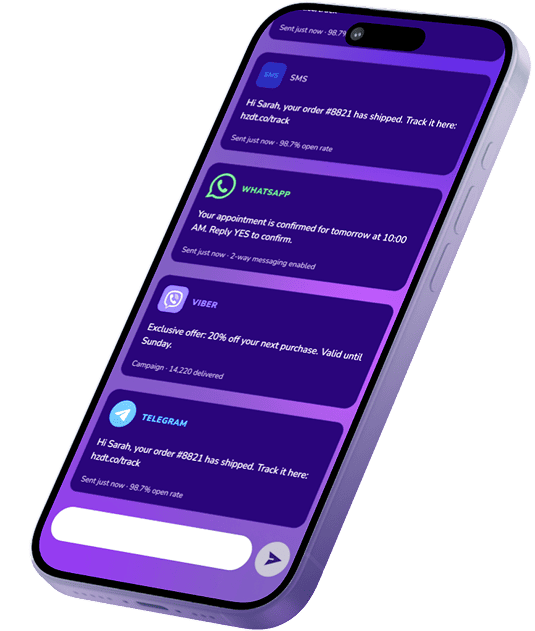
Illustration of messaging infrastructure
  1. 05

    Multi-Channel Communication

    Push notifications work alongside SMS, WhatsApp, and Voice on the same platform, giving businesses room to expand their communication strategy without adding new vendors.

  2. 06

    Real-Time Analytics

    Monitor delivery rates, open rates, and campaign performance as they happen. Every send generates actionable data that helps teams refine targeting and improve results over time.

[Industries]

Push Notifications for Every Industry That Depends
on Real-Time Customer Communication

Every industry has moments where the customer needs to know now.

The nature of those moments differs by sector. For e-commerce and logistics, push is primarily transactional, keeping customers informed at every stage of an order. For retail and hospitality, it's a mix of operational updates and targeted promotional campaigns. For banking and healthcare, it's almost entirely about security, compliance, and time-sensitive alerts where delayed delivery is not an option.

[FAQ]

Frequently Asked Questions

Push notifications are short messages sent directly to a customer's mobile app or web browser, appearing on the lock screen or desktop without requiring the customer to open an email or check an inbox. Horizon Dit's platform supports both mobile and web push from a single dashboard and API.

[Ready to Start?]

Reach Your Customers the Moment It Matters

Push notifications are how businesses stay connected to customers who are already using their product. Horizon Dit gives you the delivery infrastructure, mobile and web coverage, and regional expertise to make every send count across UAE, GCC, and MENA.

Reach customers on mobile and web with delivery your business can depend on. Real-time customer communication, across every app and every browser your customers use, starts here.

Request a Demo
one system every channel full visibility