Omnichannel Messaging Infrastructure for Coordinated Customer Interaction
The same customer. The same context. Whichever channel they choose next.
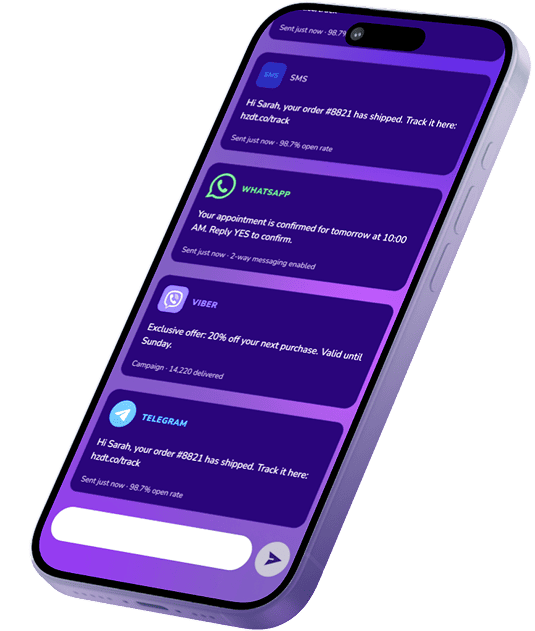
Horizon Dit coordinates WhatsApp, SMS, Push, Email, Voice, RCS, Viber, and Telegram into a single connected communication layer for businesses running customer communication across the UAE, GCC, and MENA. Instead of managing each channel on its own, one integration keeps timing, tone, and context consistent everywhere a customer shows up.
When Each Channel Runs on Its Own Logic, Customers Feel It
Different timing
A WhatsApp offer arrives the same afternoon a duplicate SMS reminder does.
Different tone
The same customer ends up feeling like they are dealing with three different companies, not one.
No shared memory
An issue explained over chat has to be explained all over again to a support agent by phone.
Most businesses already spread their customer communication across several channels. The problem is rarely a missing channel. It is each one running on its own separate logic.
None of these channels are broken on their own. What is missing is the layer that treats them as one ongoing communication flow instead of several separate ones. That missing layer is what Horizon Dit adds through Omnichannel Messaging. It coordinates the channels a business already uses, so timing, tone, and communication context carry over automatically, and an interaction that starts on one channel does not have to start over on the next.
[What This Connects]
The Channels This Page Coordinates
The channels Omnichannel Messaging coordinates across. None of them are required to start: coordination works across however many a business already has connected to its Horizon Dit account.
SMS
Reliable delivery for confirmations, account alerts, and anything urgent.
WhatsApp
Rich, conversational messaging on the channel customers open most often.
Voice
Calls and IVR for moments that call for a human tone.
Push Notifications
Instant, in-app moments for mobile and web audiences.
Email
Detailed, formal communication and documentation.
Telegram
Fast, automated messaging for an already-active audience.
Viber
Regional reach across a wider MENA customer base.
RCS
Branded, rich messaging delivered inside the native inbox.
Each channel keeps its own dedicated page with the full detail on how it works on its own.
[Core Capabilities]
What Coordination Actually Changes for the Customer
Once Horizon Dit coordinates channels instead of leaving them as separate projects, a few things change for the person on the other end of every message. None of it requires the customer to do anything differently. It changes what happens behind the scenes, in how the business keeps track of them.
Consistency Across Every Touchpoint
The same offer, the same account balance, the same order status. It should not matter whether the customer last checked in on WhatsApp, opened an email, or read an SMS an hour earlier. The information stays the same because it all comes from a single source.
Interactions That Carry Their Own History
A question raised over chat should not need to be repeated to a voice agent later that day. Context travels with the customer between channels, instead of resetting every time they switch.
Shared Context, Not Separate Channel Silos
Every interaction, on any channel, feeds the same communication context. Marketing, support, and operations teams work from that same picture, rather than three separate ones.
Campaigns Planned Once, Delivered in Sync
A single campaign calendar spans every channel a customer might see it on, replacing separate per-channel schedules that can easily overlap, repeat the same message, or contradict each other.
[One Integration]
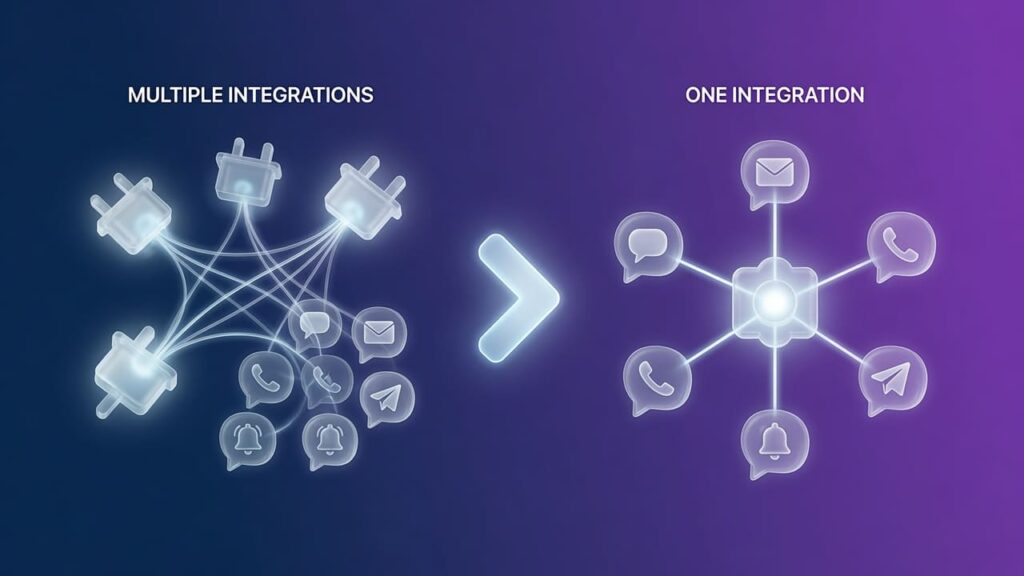
One Integration. Multiple Channels.
Every channel added to a coordinated journey usually means another integration, another API to maintain, another team to train on something new. Horizon Dit removes that multiplication. A business connects once, and every channel added after that runs through the same integration, the same account setup, and the same operational model.
For the Team That changes how a communication team scales. Adding a channel becomes a configuration decision, not an engineering project. Testing, monitoring, and troubleshooting stay consistent, because none of it has to be rebuilt separately for every new channel, and a channel can go live faster because the groundwork behind it is already in place.
At Enterprise Scale For an enterprise coordinating messaging across several markets or business units, this difference compounds over time. A single integration model, applied consistently, costs far less to operate than a growing set of disconnected, channel-specific ones.
[Platform Capabilities]
What the Platform Itself Provides
Underneath the coordination a customer notices sits a set of capabilities the platform handles automatically, not something a team has to stitch together by hand.
01
Centralized Channel Management
Every connected channel is configured, monitored, and managed together, not through separate per-channel tools, which leaves fewer places for something to go unnoticed.
02
Coordinated Communication
Every channel operates from the same trigger and timing logic, so nothing goes out of step with what a customer already received on another channel minutes earlier.
03
Communication Visibility
Status, delivery, and response activity across every channel are visible from a single operational view, not a separate dashboard per channel, so issues surface before they become customer complaints.
04
Flexible Channel Expansion
A new channel joins the coordinated setup already in place, without a rollout process of its own.
05
Unified Operational Management
A single account covers permissions and billing together, regardless of how many channels are active.
[Orchestration]
How Horizon Dit Keeps Communication Aligned Across Channels
Horizon Dit coordinates messaging in the background, using the channels already connected to an account, and follows the same logic every time a message has to land with a customer. None of this is a separate tool someone opens and manages by hand.
Step 1
A Trigger, Not a Broadcast
A coordinated message starts with something that actually happened. An order shipped. A payment failed. A customer replied to a previous message. That event sets the message in motion, instead of a fixed daily or weekly send time that goes out regardless of what is happening with that particular customer.
Step 2
Delivery Without Guesswork
Once triggered, a message still has to land somewhere the customer will actually see it. Channel selection draws on Smart Routing as one supporting input, so a business never has to hardcode which channel every message type should use.
Step 3
One Tone, One Timeline
Whether it is the first message in a sequence or the fifth, the wording and pacing stay consistent, because they come from the same coordinated campaign rather than separate ones running independently on each channel. A promotional message and a service update do not end up landing on the same customer within minutes of each other by accident.
Step 4
Context That Does Not Reset
Every delivery, reply, or click feeds back into the same communication history. If a customer responds on WhatsApp to something first sent by SMS, the next message, on any channel, starts from that updated context instead of from zero.
[In Practice]
What This Looks Like for One Customer, Start to Finish
A single order shows this more clearly than any description could: confirmation to review request, moving across three channels without losing the thread.
➜ At checkout
Order Confirmed, by SMS
Confirmation goes out within seconds of checkout, on the channel this customer has always opened fastest.
➜ 2 days later
Delivery Update, by WhatsApp
The delivery update lands inside the same WhatsApp thread the customer used yesterday to ask about their order, not as a new, unrelated message.
➜ That evening
Review Request, by Email
Once the package arrives, a review request goes out that evening, referencing the order by name instead of a generic subject line.
Three channels, three different moments, and a single connected thread tying all of it together. No manual handoff between separate tools was needed to make that happen.
[Business Benefits]
What This Means for the Business, Not Just the Customer
Coordination changes what a customer experiences, but it also changes how a communication team operates day to day, and what leadership can see across the business.
Reduced Operational Complexity Fewer handoffs between disconnected tools, so campaigns and customer updates move through the business faster.
Communication Consistency A brand that sounds the same everywhere it shows up, which is what earns trust over repeated interactions, not just a single good one.
Centralized Visibility Leadership sees how communication performs across the whole business, not just one channel at a time.
Easier Expansion A business can follow its customers to a new channel without months of rollout first.
Improved Customer Experience The kind of consistency that keeps a customer from feeling like they are starting over with a different company on every channel.
Enterprise Scalability The same coordination model holds whether a business is running messaging in a single market or across many, without added operational overhead.
[Business Scenarios]
Coordinated Messaging Through the Full Customer Lifecycle
The same coordination logic applies well beyond a single order. It carries across everything a business sends a customer, from the first signup to the point they go quiet and need a reason to come back.
Onboarding
A welcome message goes out on whichever channel the customer just signed up through. Setup reminders that follow do not repeat across every channel at once. They wait to see if the first one was opened before trying a second channel.
IDEAL FOR: first sign-ups, welcome sequences, initial account setup
Order and Fulfillment
Confirmations, status changes, and delivery notices follow a purchase from placement to arrival, each one landing on the channel most likely to get read at that particular moment rather than the same channel by default.
Examples: Order confirmation · Shipping update · Delivery notification
IDEAL FOR: post-purchase tracking, delivery updates, service scheduling
Support Continuity
An interaction that starts in chat and needs a phone call later does not lose what was already said. The agent picking up the call sees the same history the customer already gave, instead of asking them to start over.
Examples: Chat-to-call handoff · Ticket follow-up · Multi-channel case history
IDEAL FOR: multi-touchpoint support, escalations, long-running service cases
Retention and Re-engagement
A customer who has gone quiet gets a single, well-timed message on whichever channel last got a reply from them, rather than the same win-back offer arriving on three channels within the same hour.
Examples: Win-back offer · Re-engagement nudge · Lapsed customer outreach
IDEAL FOR: lapsed customers, renewal reminders, win-back campaigns
[For Developers]
A Shared API and Webhook Layer Behind Every Channel
Coordinating channels does not mean maintaining a separate integration for each one. Horizon Dit exposes a single REST API and a single webhook stream across every supported channel, so nothing has to be rebuilt per channel.
A single REST API covering every supported channel, not one endpoint apiece
One webhook stream for delivery status, replies, and communication context together
SDKs covering common programming languages for faster integration
A test environment for trying a full coordinated journey before it reaches a real customer
Pricing That Follows Message Volume, Not Channel Count
Coordinating channels does not change how Horizon Dit prices messaging. What a business pays still depends on what gets sent and how much of it, not on how many channels it chooses to coordinate.
Starter
Pay-as-you-go
For businesses coordinating their first two channels, for example SMS and WhatsApp, before expanding further.
Business
Volume Rates
For businesses running coordinated journeys and campaigns across several channels at once, with predictable monthly volume.
Enterprise
Custom
For operations coordinating high message volumes across the full channel set on Horizon Dit, with dedicated account management.
Bringing a new channel into a journey that already exists does not add a new pricing tier.
No long-term lock-in.
No hidden fees.
[Enterprise Platform]
Built for Organizations Coordinating Messaging at Scale
Coordinating messaging across channels looks different at enterprise scale than it does for a single small campaign. Multiple teams, multiple brands, and higher message volume all need to operate within the same coordinated layer, instead of splitting into a separate silo apiece.
That scaling requirement is exactly what Horizon Dit's account structure is designed around, from a single coordinated journey to many running at once, with the same consistency and visibility at every size.
[Why Horizon Dit]
Why Coordination Matters More Across the UAE and MENA
The region does not use channels the same way everywhere, or even for the same purpose. That makes coordinating them, rather than simply offering all of them, the real differentiator for a business operating here.
Trust Splits by Channel, Not by Preference
A customer in the region might trust WhatsApp to chat but still expect a confirmation or account alert by SMS. Offering only one of those channels does not just limit reach. It misses the reason customers use the other one in the first place.
Language and Market Habits Vary by Country
What works in Dubai does not automatically read the same way in Riyadh or Cairo. Coordinating channels means the same customer journey can adjust its language and channel mix by market, without being rebuilt for each one.
A Single Coordinated Layer Instead of Regional Workarounds
A business selling across the UAE, wider GCC, and MENA is coordinating more than channels. It is coordinating different local habits at once, without a separate workaround built for each individual market.
[Industries]
The Same Coordination Layer, Different Industries, Different Journeys
Every industry Horizon Dit serves sends a different mix of messages, but each one needs the same thing underneath: channels that work together instead of on their own. A retailer coordinates order and delivery updates. A bank coordinates account alerts and statements. A healthcare provider coordinates appointment reminders and follow-ups. The channels and the message types differ by industry. The need for a single coordinated layer behind them does not.
Omnichannel messaging means coordinating every channel a business uses into a single ongoing communication flow with each customer, instead of running each channel as its own separate project. The customer experience stays consistent no matter which channel they are on at a given moment.
Multichannel means a business is present on several channels. Omnichannel means those channels are coordinated with each other, sharing the same communication context, timing, and tone, so an interaction on one channel picks up where the last one left off instead of starting over.
Every channel Horizon Dit currently supports: SMS, WhatsApp, Telegram, Viber, RCS, Voice, Push Notifications, and Email. A business does not need to use every one of them to benefit. Coordination works across however many channels it already has active.
Channel selection draws on Smart Routing among other factors, such as which channel a customer has engaged with recently and what type of message is being sent.
No. Pricing is based on total message volume, not on the number of channels connected to an account. Coordinating an additional channel does not move a business into a different pricing tier by itself.
Yes. Coordination does not require using every available channel. It works the same way whether a business connects two channels or all eight, applying the same shared context and consistent timing across whichever channels are active.
Not quite. A shared inbox brings incoming messages into a single screen for a support team. Omnichannel Messaging goes further, coordinating outbound and inbound messages together across marketing, transactional, and support use cases, so the coordination covers the whole customer relationship, not just customer support.
No. It works with whichever channels a business already has active on Horizon Dit. There is no separate platform to adopt or migrate to first.
[Ready to Start?]
Bring Every Channel Together Into Coordinated Communication
Every channel connected to a Horizon Dit account already works together as a single coordinated layer, not as separate tools stitched together after the fact. See what that looks like across your own customer journeys, from the first message to the last.
Consistent, coordinated communication, no matter which channel a customer picks.
Enter your email address to receive a new password.
Please check your email inbox
Contact Sales
Get expert guidance on channels, setup, and messaging strategy.
This website uses cookies
We use necessary cookies to make our website and web-based interface work. To get more information about these cookies, how and why we use them and how you can change your settings, check our Cookie Preferences.