






Skip to content
[Infrastructure]

Enterprise Messaging Infrastructure

Built as the platform foundation every channel and Solution runs on.

Whatever channel a business uses to reach a customer, that message runs through the same underlying platform. This page explains the architecture, principles and operational approach behind it: what it is built to support, how it stays visible to the teams running it, and why it is designed to keep working as messaging requirements grow.

Request a Demo
  • Enterprise Architecture
  • Scalable Platform
  • Operational Visibility
  • Regional Infrastructure
[Platform Foundation]

A Platform Built Before the Channels Were Added

  • One Foundation, Every Channel

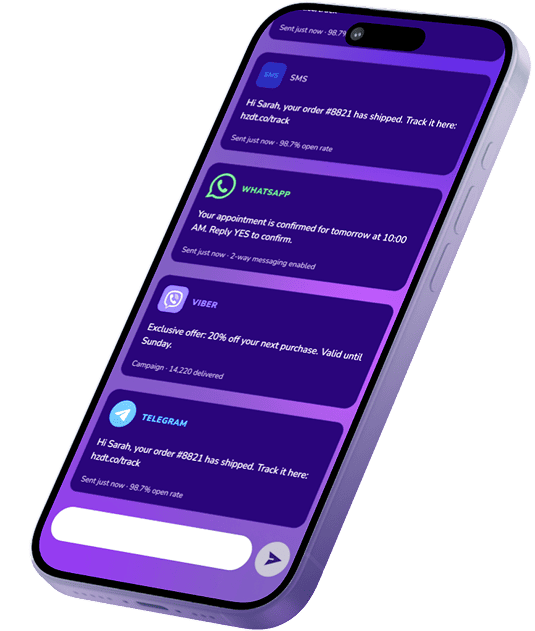
    SMS, WhatsApp, Voice, Email and every other channel on Horizon Dit sit on the same platform underneath, not separate systems stitched together.

  • Consistent at Any Volume

    A quiet week and a busy one run through the same platform underneath, without a different setup for either.

  • Room to Add More

    A new channel, region or Solution extends this foundation instead of becoming a separate infrastructure project of its own.

Enterprise messaging is often evaluated channel by channel: SMS deliverability, WhatsApp approval, email reputation. Each of these matters. None of them, on its own, explains whether an organization can run business-critical communication on a provider for years, not months.

That question is answered by what sits underneath the channels: the platform that receives every send, tracks its outcome, and stays consistent whether a business is sending a few thousand messages a day or considerably more. Horizon Dit's Channels and Solutions all run on this shared foundation.

This page sets out how that foundation is built: the principles behind it, the architecture that connects it to a business's own systems, and how it is designed to support enterprise workloads as they grow. It is one part of what Horizon Dit covers under Trust, alongside how the platform approaches Compliance.

[Why It Matters]

Infrastructure Problems Rarely Announce Themselves. They Just Get Expensive.

Problems with messaging infrastructure rarely show up on day one. They surface later, once volume, regions or teams multiply and a setup that worked at a smaller scale starts to strain. Three concerns tend to define whether that strain becomes a business problem.

Reliability

A messaging setup that depends on one fragile link works fine until it doesn't, and the cost of that failure grows with how much of the business depends on the message getting through. Infrastructure built with resilience in mind reduces how much any single dependency can affect the wider communication flow.

Scalability

A platform sized for last year's volume becomes a constraint the moment growth accelerates, forcing a choice between throttling communication or re-platforming under pressure. Infrastructure designed to scale absorbs that growth as a normal event rather than an emergency.

Operational Visibility

Teams cannot manage what they cannot see, and a messaging setup without clear visibility into delivery and platform health leaves problems to be discovered by customers first. Infrastructure built for visibility surfaces that information to the teams responsible for it, before it becomes a support ticket.

[Engineering Principles]

What Guides How the Platform Is Built and Operated

These principles guide how the Horizon Dit platform is built and operated. They are not a list of features. They describe the reasoning behind how the platform behaves as usage grows and requirements change.

  1. 01

    Reliable by Design

    Messaging infrastructure is structured with resilience in mind, so that one weak point in the delivery path does not have to become an outage for the whole system. For a business, that means fewer moments where a communication problem becomes a customer-facing one.

  2. 02

    Built to Scale

    The platform is engineered to handle growing messaging workloads, so that a typical increase in volume does not call for moving to a different platform. Growth in messages, regions or channels can be absorbed by the existing foundation rather than treated as a separate infrastructure project.

  3. 03

    Observable by Default

    Operational monitoring and delivery visibility are part of the platform itself, not an add-on a business has to configure. Technical teams can see what is happening with their messaging activity as it happens, down to the delivery status of an individual message, rather than reconstructing it after a customer complaint. A searchable message history makes it possible to trace a specific send without opening a support ticket.

Illustration of messaging infrastructure
  1. 04

    API-First

    Horizon Dit is structured around an API-first model, so connecting the platform to existing business systems is a standard integration task rather than a custom project. This keeps messaging capabilities usable from wherever a business's other systems already run.

  2. 05

    Enterprise Ready

    The platform is developed with enterprise workloads in mind: predictable operation at higher volumes, integration into established environments, role-based access that lets an organization control who can see or act on what within an account, and the kind of consistency a business-critical process needs from the systems underneath it.

[Platform Architecture]

How a Message Moves Through the Platform

Conceptually, Horizon Dit's platform can be described as five layers, each with a distinct role. None of them require a business to understand or manage the underlying implementation, only to know what each layer is responsible for.

  1. Step 1
    Business Applications
    The systems a business already runs – CRM, ecommerce platforms, internal tools – where a message originates as a business event.
  2. Step 2
    API Layer
    The point where a business system connects to Horizon Dit: one API surface used to send messages, receive delivery status and integrate messaging into an existing workflow.
  3. Step 3
    Messaging Platform
    The core of Horizon Dit: the layer that receives each message, applies the relevant channel and Solution logic, and manages it through to delivery, keeping messaging activity centralized in one account rather than scattered across separate channel tools.
  4. Step 4
    Operational Visibility
    Monitoring and delivery visibility running across the platform, surfaced as delivery status, message search and reporting, giving technical and operational teams a consistent view of message activity and platform health.
  5. Step 5
    Messaging Connectivity
    The layer that connects Horizon Dit to the messaging providers a message needs to reach its destination, across the UAE, GCC, MENA and international markets.
[Enterprise Scale]

Built With Room to Grow Into

Messaging volume for a growing business rarely increases in a straight line. A campaign, a new market or a busier season can multiply how many messages go out in a short window, and a platform sized only for average load struggles exactly when it matters most. Horizon Dit's infrastructure is built to accommodate that kind of variation as a normal operating condition rather than an exception.

The same principle applies beyond volume. Adding a region, a channel or a Solution should extend what a business already has on Horizon Dit, not require a separate system alongside it. Because Channels and Solutions share the same underlying platform, expansion adds to existing infrastructure instead of creating a second, disconnected one to manage.

This is what "built for enterprise scale" means in practice: fewer moments where growth forces a choice between limiting communication and starting an infrastructure project from scratch.

[Visibility & Reliability]

Visibility and Reliability Answer Different Questions

Visibility and reliability answer two different questions. Visibility is about knowing what is happening with messaging activity right now. Reliability is about how the platform is built to keep working when conditions change. Horizon Dit treats them as related but distinct.

Operational Visibility

Platform monitoring and delivery visibility give technical and operational teams a consistent view of message activity, from status through the message lifecycle to platform health. Rather than waiting for a customer to report that something did not arrive, teams can see delivery patterns and platform behaviour directly, which shortens how long a delivery issue stays unnoticed. This visibility is available through the same account experience used to manage messaging, not a separate system layered on top.

In practice, this includes delivery status for every message sent, a searchable message history for tracing a specific conversation or transaction, and reporting on messaging volume and delivery performance by channel. Role-based access lets different teams, operations, support, engineering, work from the view relevant to them, rather than one shared, undifferentiated screen.

Reliability

Reliability, on this platform, is an engineering principle rather than a contractual promise. Infrastructure designed with resilience in mind avoids depending on a single weak point for the entire messaging flow, and is structured to support continuity of operations as conditions change. Specific availability commitments are addressed separately, as part of a customer's commercial agreement. Resilience itself is treated as a design objective throughout the platform, not something addressed only once a problem occurs.

[Connectivity]

Delivery Conditions Aren't the Same in Every Market

Every market a business communicates in has its own delivery conditions.

  • Different Markets, Different Conditions
    Different operators, different channel adoption and different expectations for how a message should arrive. Horizon Dit's connectivity layer is built to work across that variation rather than assuming one set of conditions applies everywhere.
  • Concentrated Across the UAE, GCC and MENA
    This matters most across the UAE, GCC and MENA, where Horizon Dit's regional experience is concentrated, and where channel preference and operator landscape can vary considerably between markets within the same region. The same infrastructure also supports international messaging beyond this region, for businesses whose customers are not confined to one geography.
  • Absorbs New Markets and Channels
    As Horizon Dit adds markets or channels, this connectivity layer is what absorbs that expansion, so a business's own integration does not need to change each time its communication footprint grows.
[For Developers]

Integration Runs Through One API Layer

Connecting messaging into an existing business system – a CRM, an ERP, an ecommerce platform, an internal application – is designed as a standard integration task, not a custom build. One consistent API layer handles sending, while authentication, webhook-based delivery callbacks and reporting data all flow back through the same integration to the systems that need them.

  • One REST API that handles sending and integration into an existing workflow, rather than a separate endpoint per channel or Solution
  • One webhook stream carrying delivery status and callbacks back to a business's own systems
  • Reporting data available through the same integration, alongside sending and delivery status

This page keeps that story at a business level. Endpoint structure, authentication implementation and integration walkthroughs belong to Horizon Dit's developer documentation, not to an infrastructure overview.
View Developer Documentation
REST API
Webhooks
Reporting
[Solutions on This Foundation]

The Same Foundation Under Every Solution

Omnichannel Messaging, Smart Routing and Customer Verification, covered together on the Solutions Hub, are built on the infrastructure described on this page. Each Solution can be used on its own or alongside the others, but all of them draw on the same underlying platform rather than separate systems maintained independently.

  • Omnichannel Messaging

    Coordinating a customer's communication across channels depends on a platform that keeps message history and context consistent underneath. Infrastructure is what makes that consistency possible at any volume. → Explore Omnichannel
  • Smart Routing

    Choosing the right delivery path for a message, in real time, relies on the same platform layer that handles the delivery visibility and connectivity described on this page. → Explore Smart Routing
  • Customer Verification

    Verifying a user through the right channel, at the right moment, depends on infrastructure that stays reliable and observable for every request, not only the routine ones. → Explore Customer Verification
[Business Outcomes]

The Payoff of Getting This Right

Infrastructure decisions rarely show up on their own line in a business case. They show up in how often communication breaks, how much a growing business has to rebuild, and how much confidence a team has in what they cannot directly see.

  • Lower Operational Risk
    Communication that depends on resilient infrastructure is less exposed to one weak link disrupting business-critical processes.
  • More Predictable Communication Operations
    Consistent platform behaviour, backed by reporting on delivery and volume trends, makes messaging operations easier to plan around, instead of a source of recurring surprises.
  • Easier Platform Growth
    Because Channels and Solutions share the same foundation, growth adds to existing infrastructure rather than requiring a parallel system.
  • Reduced Integration Complexity
    An API-first platform, with delivery callbacks built into the same integration, keeps connecting new systems to messaging a standard task, not a custom project each time.
  • Faster Expansion
    Entering a new market or adding a channel extends infrastructure that already exists, rather than starting integration work from zero.
  • Long-Term Platform Flexibility
    A platform built to scale and stay observable is less likely to need replacing as an organization's messaging requirements evolve.
[Industries]

Supporting Every Industry Horizon Dit Serves

Ecommerce, finance, logistics, healthcare and every other sector Horizon Dit serves place different demands on messaging, but all of them depend on the same thing underneath: infrastructure that keeps working as volume and complexity grow.

[FAQ]

Frequently Asked Questions

It is the underlying platform that supports messaging Channels and Solutions – how messages are processed, monitored and delivered, and how that platform is designed to stay reliable and scalable as an organization's communication needs grow.

[Ready to Start?]

See What This Infrastructure Can Support

This infrastructure already supports every Channel and Solution Horizon Dit runs today. Bring your own volume, regions and integration requirements to see how it holds up.

Request a Demo
one system every channel full visibility