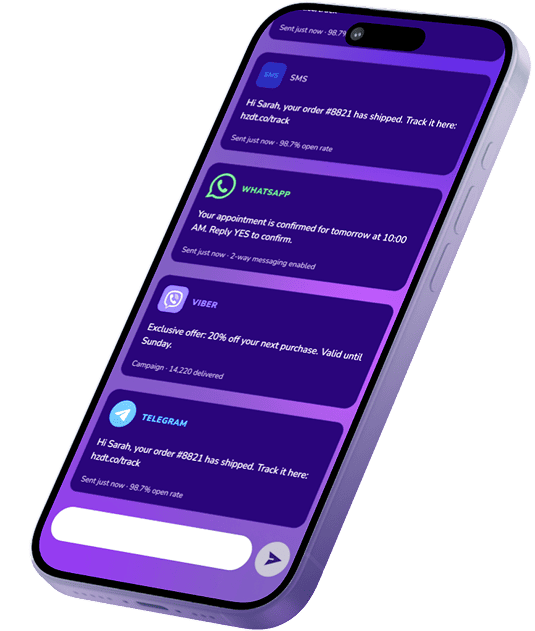
Smart Routing Infrastructure for Automatic Delivery Path Selection
The same message. A different customer. A different path, chosen every time it sends.
Horizon Dit decides automatically which of SMS, WhatsApp, Voice, Push, Email, Telegram, Viber, or RCS a message should travel through, so a business reaching customers throughout the UAE, GCC, and MENA never has to choose manually. Rather than a static channel assignment answering for every message, the platform reads deliverability, cost, and recipient behavior in real time and picks accordingly.
When Every Message Takes the Same Channel, Some Never Arrive
A Rule, Not a Decision
A channel gets picked once, in advance, then used for every message regardless of what changes afterward.
Failures Stay Invisible
A channel that stops reaching a customer does not raise an alert. It simply stops arriving.
One Cost for Everything
A security code and a promotional blast travel the same channel, at the same cost.
Most businesses assign each message type to one channel and leave that assignment in place indefinitely. The assignment rarely gets revisited once it is set.
Delivery conditions do not stay still. A channel's reach shifts by operator, by market, and by the individual recipient, while a fixed rule keeps sending the same way regardless. Smart Routing closes that gap for each individual message, weighing deliverability, cost, and recipient behavior the instant it is about to send, without a person deciding it by hand.
This sits underneath the wider coordination Omnichannel Messaging provides across a customer's full communication history.
[What This Connects]
The Channels Smart Routing Chooses Between
Smart Routing spans whichever channels are currently active, without treating any one as a default. The decision of which one carries a given message happens automatically, per message, per recipient.
SMS
Chosen when a confirmed delivery record outweighs how polished the message looks.
WhatsApp
Often the fastest path in markets where adoption already runs high.
Voice
Reserved for messages that call for an automated call or a live conversation.
Push Notifications
The quickest route for a customer already inside the app or on the site.
Email
Selected when the content calls for careful reading, not a quick glance.
Telegram
An efficient path to audiences already active on it.
Viber
Chosen where MENA reach needs to extend past the Gulf, into markets where Viber's own footprint runs deeper.
RCS
Chosen when a richer, native-inbox format outweighs narrower device support.
[How It Decides]
How Smart Routing Decides, One Message at a Time
Smart Routing runs in the background on every message sent through a connected account, weighing the same set of signals each time rather than applying a fixed rule written in advance. None of this requires a dashboard someone checks message by message.
Step 1
A Signal, Not a Guess
Every message carries its own signals before it sends: how urgent it is, what it costs to deliver on each available channel, and how that particular recipient has responded to past messages. Smart Routing reads all three together, rather than defaulting to whichever channel was configured first.
Step 2
A Path, Chosen in the Moment
The platform picks a channel for that specific message at the moment it is ready to send, not from a table set up weeks earlier. The same message can take a different path tomorrow if conditions have shifted since today.
Step 3
A Reroute, Not a Retry
If the first channel does not confirm delivery within an expected window, Smart Routing moves the message to the next best path automatically. This is not the same message repeated on the same channel; it is a different channel picking up where the first one stalled.
Step 4
A Record, Feeding the Next Decision
Every delivery outcome, successful or not, updates what Smart Routing knows about that channel and that recipient. The next message benefits from what the last one revealed, instead of every decision starting from the same fixed assumptions.
[In Practice]
What a Single Message Actually Does, Before It Lands
One failed-payment alert makes the mechanics concrete: sent once, given a short window to confirm, then handed to a different channel the instant that window closes.
➜ The instant it sends
Alert Sent, by Push
The failed-payment alert goes out as a push notification first, the fastest channel for a customer already inside the app.
➜ A few seconds later
No Confirmation Yet
No open or delivery confirmation comes back inside the expected window. Smart Routing does not wait past that point or resend the same push notification.
➜ Automatically
Delivered, by SMS
The same alert reaches the customer by SMS instead, landing before the payment issue can delay the order any further, with no manual intervention involved.
One message, one decision changed mid-flight, and no person involved in making that call. The same decision process holds whether the message is an alert, a receipt, or a reminder.
[Customer Experience]
The Recipient Sees a Result, Never the Decision Behind It
A recipient never sees the decision happen, only its result: a message that reaches them on a channel that actually works for them, roughly as fast as it can. None of this asks anything of the customer. The shift happens earlier, before the message is ever visible to them.
Fewer Messages That Never Arrive
A message that would have quietly failed on one channel gets an automatic second attempt on a different one, within moments, without the recipient ever noticing that anything went wrong the first time around.
Delivery Speed That Matches Urgency
A time-critical alert does not sit behind the same processing as a routine update; the channel chosen for it reflects how quickly that particular message actually needs to land with the recipient.
A Channel That Fits the Recipient
Two customers receiving the exact same type of message can end up on two different channels, each one the path that has actually reached them reliably in the past.
No Extra Steps on Their End
None of this asks a customer to set a preference or pick a channel themselves; the adjustment happens entirely on the sending side, based on what has already been observed.
[Platform Capabilities]
Five Mechanics an Account Never Has to Manage
Smart Routing carries out several distinct mechanics on every message, none of which a team needs to touch by hand once the account is connected.
01
Deliverability Scoring
Each channel's recent success rate for a given recipient feeds directly into which path gets chosen next, rather than treating every channel as equally reliable by default.
02
Cost-Aware Selection
Price per message factors into the decision alongside speed and reliability, so a routine update does not default to the most expensive available channel out of habit.
03
Automatic Failover
A stalled or unconfirmed delivery triggers a switch to the next channel without anyone having to notice the failure first.
04
Recipient-Level Memory
Past delivery outcomes for a specific recipient carry forward, so the routing decision improves for that person over repeated messages, not just in general.
05
Configurable Priority Weighting
A business can tell the engine to lean harder on one signal than another for a given message type, so a security alert favors speed while a promotional send favors cost, without touching the mechanics underneath.
[Business Impact]
The Cost and Reliability Case for Automatic Routing
Every routing decision affects more than one message. Across an entire account's volume, the same mechanics change what a business spends and how often a message actually lands.
Lower Cost Per Delivery Messages default to the least expensive channel that will still do the job, rather than the most expensive one by default.
Fewer Failed Deliveries to Chase Support teams spend less time tracing why a specific message never arrived, since the platform already tried an alternate path.
Visibility Into Delivery Performance Leadership can see how well each channel is actually performing for real message traffic, not just how it is expected to perform.
Consistent Behavior at Any Volume The mechanics stay the same whether an account is just getting started or already sending at full enterprise scale.
Fewer Manual Exceptions to Manage Teams do not need a running list of special-case rules for markets or message types that behave differently, since the engine already adjusts for that.
Scales Without Added Overhead Adding a new channel or entering a new market does not require rebuilding the routing rules from scratch.
[Business Scenarios]
Automatic Routing Across Every Kind of Message a Business Sends
The same decision engine applies to every message a business sends, not just one type. What changes from one scenario to the next is which signal matters most: speed, cost, certainty, or the recipient's own history.
Time-Critical Alerts
A security alert or urgent account notice gets the fastest available channel and a short confirmation window; if nothing comes back in that window, the message moves automatically to the next-fastest option.
A payment receipt or shipping update favors a channel with a strong delivery record over the cheapest option, since missing a transactional message costs more than the extra send would.
IDEAL FOR: transactional updates, purchase confirmations, service notices
Marketing and Promotional Sends
A seasonal offer or newsletter goes out at the lowest reasonable cost across a large recipient list, since a few extra minutes of delay costs nothing next to what a security alert or payment update would risk by moving slowly.
Two recipients on the same list can receive the identical message on two different channels, based on which one has actually reached each of them before, rather than one rule applied to everyone.
Examples: Loyalty update · Service reminder · Renewal notice
A business sending across several countries does not need a separate configuration per market; the platform adjusts for operator-level differences in deliverability on its own, market by market.
Nothing about Smart Routing sits behind a closed system. Delivery-path data surfaces through the same endpoints already used for sending and tracking every channel, so a team does not need a second system to understand why a message went where it did.
Delivery-path metadata included in every webhook event, not a separate lookup
Per-message routing logs available through the same API used for sending
Configurable priority rules for teams that want to weight one signal more heavily
A way to preview which path a test message would take, without it actually going out to a real recipient
You Pay for Messages Sent, Not for the Decisions Behind Them
Smart Routing has no separate line on the invoice. Whatever a message would have cost without automatic routing is what it costs with it: price is set by the message and the channel, not by the decision layer choosing between them.
Starter
Pay-as-you-go
For businesses sending across two or three channels and letting the engine pick the path for each message as they go.
Business
Volume Rates
For businesses with steady monthly volume across several channels, where automatic routing runs continuously rather than case by case.
Enterprise
Custom
For accounts that need custom routing terms and support built around very large sending volumes.
Routing decisions never add a separate line item to the bill.
No long-term lock-in.
No hidden fees.
[Enterprise Platform]
Different Brands, Different Volumes, the Same Underlying Engine
An enterprise account rarely represents a single, uniform stream of messages. Different brands, different regions, and very different volumes can all sit inside one account at once, each with its own mix of urgency, cost sensitivity, and recipient behavior.
None of that needs separate configuration. Smart Routing scores, fails over, and prices each stream on its own terms, so heavier activity in one brand or region leaves the routing behavior for every other one untouched.
[Why Horizon Dit]
Regional Delivery Conditions the Engine Has to Account For
Channel reach and reliability do not hold steady across every market this platform serves. That unevenness is exactly the condition Smart Routing is built to work with, rather than something a business has to track manually market by market.
One Channel's Reach Varies by Country
A channel that reaches most customers reliably in the UAE can behave quite differently once you look at Iraq or the wider Levant, where different apps and networks dominate instead. Smart Routing adjusts for that automatically, market by market.
Operator Behavior Is Not Uniform Across the Region
Etisalat, du, and other regional carriers do not all handle every channel identically. A path that delivers cleanly through one operator can behave differently through another, and the routing decision accounts for that rather than assuming one carrier's behavior everywhere.
No Manual Adjustment Needed Per Market
A single account operating throughout the UAE, GCC, and MENA does not need its own routing configuration written separately for every country it operates in. The engine adapts to local delivery conditions on its own.
[Industries]
The Same Decision Engine, Different Industries, Different Stakes
Every industry sends its own mix of urgent and routine messages, and Smart Routing treats that mix differently depending on what is actually at stake.
A retailer's flash-sale blast and its failed-delivery alert do not travel the same way. A bank's fraud warning and its monthly statement do not either. Neither does a travel company's gate-change notice and its loyalty offer.
What changes industry to industry is the message mix; the decision logic underneath stays the same.
Smart Routing is the decision layer that picks which channel a specific message travels through, based on deliverability, cost, and how that recipient has responded to messages before. It runs on every send, not as a one-time setup choice.
Omnichannel Messaging coordinates a customer's communication history across channels over time. Smart Routing decides, message by message, which single channel a given send should use right now, at the level of one message rather than the whole relationship.
Every channel currently connected to an account: SMS, WhatsApp, Voice, Push Notifications, Email, Telegram, Viber, and RCS. None has to be prioritized manually; the decision happens automatically for each message.
No. That decision belongs to how a business handles authentication. Smart Routing only decides which channel carries a message once it already exists, including a verification code, without making the authentication decision itself.
No. Cost still comes down to total message volume and which channels carry it, the same basis as sending without any routing logic involved. Automatic routing does not add its own separate charge.
Priority rules can weight certain signals more heavily for specific message types, but Smart Routing still makes the final per-message decision automatically rather than requiring someone to pick a channel by hand each time.
Smart Routing works through the available paths in order of likely success. If all of them fail, the message is marked undelivered rather than silently dropped, so the failure is visible rather than unnoticed.
No. It operates across whichever channels an account currently has active, whether that is two or all eight. Adding a channel later simply gives the engine one more option to choose from.
[Ready to Start?]
Let Every Message Find Its Own Best Path
Smart Routing already runs on every channel active in an account, evaluating each message as it sends, without any separate setup step. Bring your own message types and delivery data to see the specific paths it would pick.
A path chosen automatically, for every message, every time.
Enter your email address to receive a new password.
Please check your email inbox
Contact Sales
Get expert guidance on channels, setup, and messaging strategy.
This website uses cookies
We use necessary cookies to make our website and web-based interface work. To get more information about these cookies, how and why we use them and how you can change your settings, check our Cookie Preferences.